

Sex, intimacy, and desire discrepancy may be the most common concerns couples bring to me, and they’re also some of the hardest to talk about. By the time a couple reaches me, they’ve often spent years quietly misreading each other’s behavior and feelings. One partner might think, “They must not find me attractive anymore.” The other might feel resentful and conclude, “They only touch me when they want sex.” Both partners can end up feeling rejected, pressured, or misunderstood, and sex becomes such a loaded topic that it feels easier to avoid it entirely.
One of the most helpful frameworks I use with couples to break this pattern is the Dual Control Model of sexual response. It gives partners a shared, non-judgmental language for talking about arousal and desire. It moves the conversation away from “What is wrong with us?” and toward understanding what each person needs.
What Is the Dual Control Model?
The Dual Control Model was developed by John Bancroft and Erick Janssen, researchers at the Kinsey Institute. They proposed that sexual response is governed by two separate systems (Bancroft & Janssen, 2000; Bancroft et al., 2009). Emily Nagoski brought the model to a general audience in her book Come as You Are: The Surprising New Science That Will Transform Your Sex Life, using the metaphor of an accelerator and a brake.
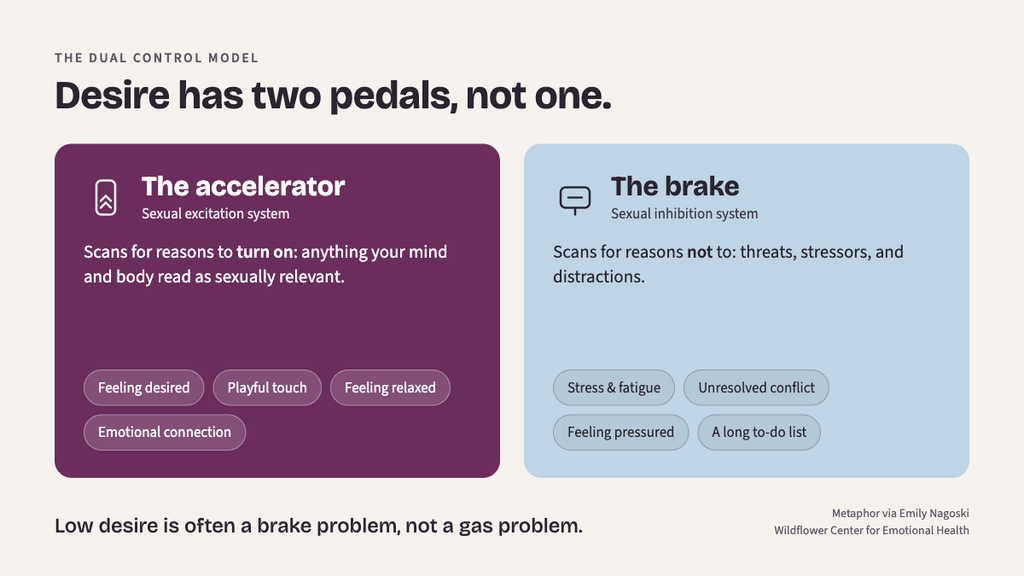
The Sexual Excitation System (the accelerator) scans your environment, your body, and your thoughts for anything it perceives as sexually relevant. That might be a touch, a smell, a look, a memory, or the feeling of being desired. When it notices something, it sends the arousal signal.
The Sexual Inhibition System (the brake) scans for reasons not to be turned on, such as a perceived threat, a distraction, or a stressor. When it notices something, it sends the “turn off” signal.
Your sexual response at any given moment is the combination of what both systems are doing. This matters because many couples assume that low desire means there isn’t enough “gas.” Very often, the problem isn’t a weak accelerator but a brake that’s being pressed too hard. It works like driving a car: you can floor the accelerator, but if the brake is on, you aren’t going anywhere.
Sexual Temperament: Your Unique Settings
Everyone has their own sensitivity in each system, often called your sexual temperament. Research shows that these traits vary widely from person to person (Janssen et al., 2002; Carpenter et al., 2008; Panzeri et al., 2021). Some people have very sensitive accelerators and get turned on by a wide range of cues. Others have less sensitive accelerators and need more specific, intentional input. Some have brakes that are triggered by even minor stressors, and others have brakes that rarely engage.
None of these combinations is better or worse. They’re simply different. Your sexual temperament is not a verdict on your relationship, your attraction to your partner, or your worth. It’s information about how your nervous system works, and it’s information you and your partner can use to build a better sex life.
These systems also aren’t fixed. Think of your temperament as a baseline, but know that how it shows up can shift from one season of life to the next. Someone whose brake rarely engages may find it highly sensitive during a stressful stretch, such as after the birth of a child.
Examples of Accelerators and Brakes
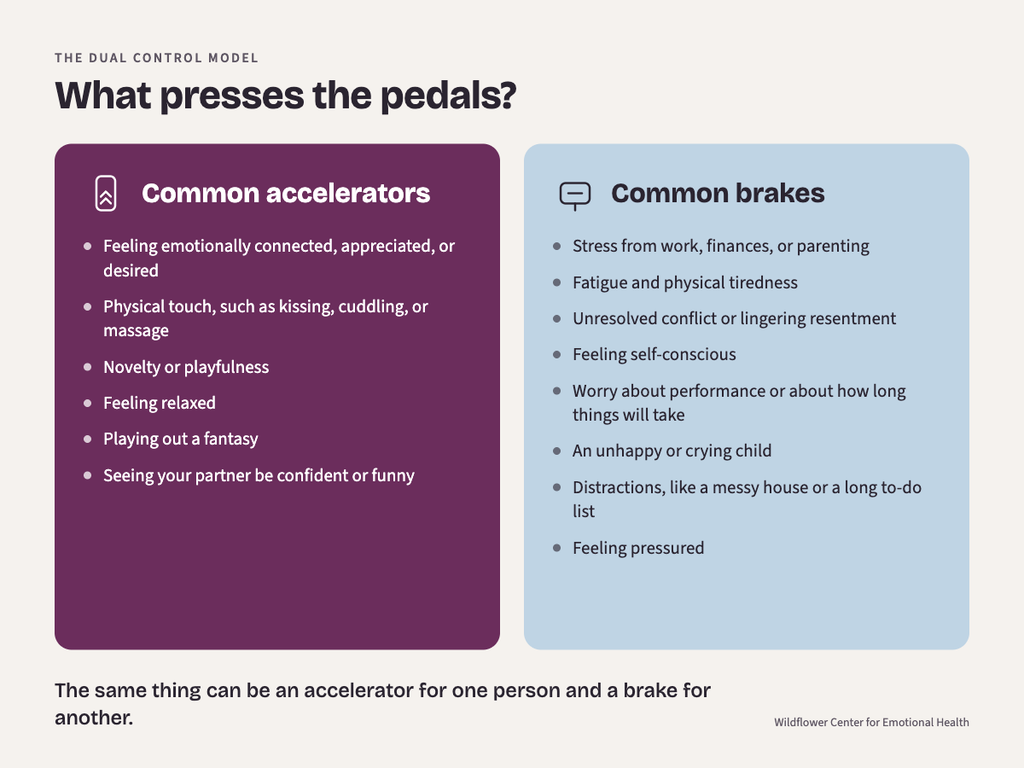
What presses the accelerator and what hits the brake is highly individual. There are no universal accelerators or brakes, and the same thing can be an accelerator for one person and a brake for another. Here are some common examples.
It’s Normal to Be Different
Differences in desire don’t mean something is broken in your relationship. In nearly every relationship, partners have different temperaments; matching temperaments are the exception, not the rule. The Dual Control Model doesn’t point to a “correct” amount of desire. It helps us understand why desire shows up easily in some moments and not in others.
Without a framework like this, we tend to fill in the gaps with the most painful explanation available. Our mind might tell us that a partner who isn’t interested in sex right now doesn’t care about us. A partner who initiates often might be seen as someone who’s only after sex. The Dual Control Model replaces these stories with a more accurate and more compassionate question: What’s pressing on the brakes, and what would help with the accelerator?
Using the Model in Your Relationship
1. Start by reflecting on your own. Before talking with your partner, spend some time considering your own accelerators and brakes. Think back to times when desire or arousal came easily. What was present? When it was difficult, what got in the way? Be as specific as you can. Writing your thoughts down helps you remember them and gives you something to refer back to.
2. Share your lists without judgment. When you talk, remember the rules from other structured conversations: this is not a time to criticize, defend, or problem-solve immediately. You are simply both sharing your inner world. Listen to each other. Be curious, and thank each other for being honest. If you have a regular State of the Union conversation, you might build a few of these topics into it, and if either of you gets flooded, remember to take a break and return to it when you are calm.
3. Ease off the brakes before adding more gas. Many couples instinctively try to boost the accelerator by planning a romantic dinner or a weekend away. These can help, but if the brakes are still on, they may not make much difference. Often the most effective approach is to address what’s pressing the brakes. That might mean sharing the household workload more evenly, resolving a lingering conflict, creating more downtime, or setting up a space where you’re less likely to be interrupted. I’ve found this especially true for new parents.
4. Lower the stakes of physical touch. If either partner worries that any touch will be read as an invitation to sex, the brakes may stay firmly on. Affectionate, playful, sensual touch that doesn’t need to lead anywhere can slowly rebuild safety and warmth. It also shows your partner that you aren’t just looking for sex, and that you can enjoy each other in low-pressure ways.
5. Stay curious and check in regularly. Your accelerators and brakes will change over time. Checking in periodically lets you adjust as life changes, rather than letting a mismatch grow into resentment.
Questions to Ask Each Other
These questions can help you get you started. You don’t need to answer them all at once, and it’s fine to begin with the ones that feel least intimidating.
- What helps you feel relaxed and open to physical closeness?
- What are some things I do (or that happen in our lives) that make it easier for you to feel connected to me?
- What tends to get in the way, or make it harder to be present?
- Are there times of day, places, or situations where you feel most receptive?
- How does stress affect your interest in intimacy? Does it turn it down, or turn it up?
- Is there anything I do that makes you feel pressured, even when I don’t mean to?
- What kinds of touch do you enjoy that don’t need to lead to sex?
- What’s one small thing I could do this week to help you feel closer to me?
- How would you like me to let you know I’m interested, and how would you like to let me know when you’re not?
Remember that the goal of these questions is understanding, not agreement. You’re learning about your partner’s world while offering them a view of yours.
When to Seek Additional Support
These conversations can be hard to have on your own, especially when there’s been significant hurt, a history of trauma, or a long period of avoidance. Medical factors can also play a role, such as hormonal changes, medications, chronic pain, or other health conditions, and these are worth discussing with your doctor. A couples therapist can help you navigate these conversations, spot patterns that are hard to see from the inside, and move toward a more satisfying and connected intimate life. You don’t have to figure this out alone.
Understanding your sexual temperament isn’t about changing who you are. It’s about learning how you work, learning how your partner works, and building a relationship where you both feel safe, wanted, and understood. If you’d like support exploring this in your own relationship, please reach out to our intake team at Wildflower.
References
Bancroft, J., & Janssen, E. (2000). The dual control model of male sexual response: A theoretical approach to centrally mediated erectile dysfunction. Neuroscience & Biobehavioral Reviews, 24(5), 571–579.
Bancroft, J., Graham, C. A., Janssen, E., & Sanders, S. A. (2009). The dual control model: Current status and future directions. Journal of Sex Research, 46(2–3), 121–142.
Carpenter, D., Janssen, E., Graham, C., Vorst, H., & Wicherts, J. (2008). Women’s scores on the Sexual Inhibition/Sexual Excitation Scales (SIS/SES): Gender similarities and differences. Journal of Sex Research, 45(1), 36–48.
Janssen, E., Vorst, H., Finn, P., & Bancroft, J. (2002). The Sexual Inhibition (SIS) and Sexual Excitation (SES) Scales: I. Measuring sexual inhibition and excitation proneness in men. Journal of Sex Research, 39(2), 114–126.
Nagoski, E. (2015). Come as you are: The surprising new science that will transform your sex life. Simon & Schuster.
Panzeri, M., Dadomo, H., Ronconi, L., & Fontanesi, L. (2021). Validation of the Sexual Inhibition/Sexual Excitation Scales (SIS/SES) in Italy: Assessing gender and age differences of sexual functioning. Archives of Sexual Behavior, 50(6), 2755–2772.

Curious about what sex therapy entails? Check out this and our other educational guides here.