
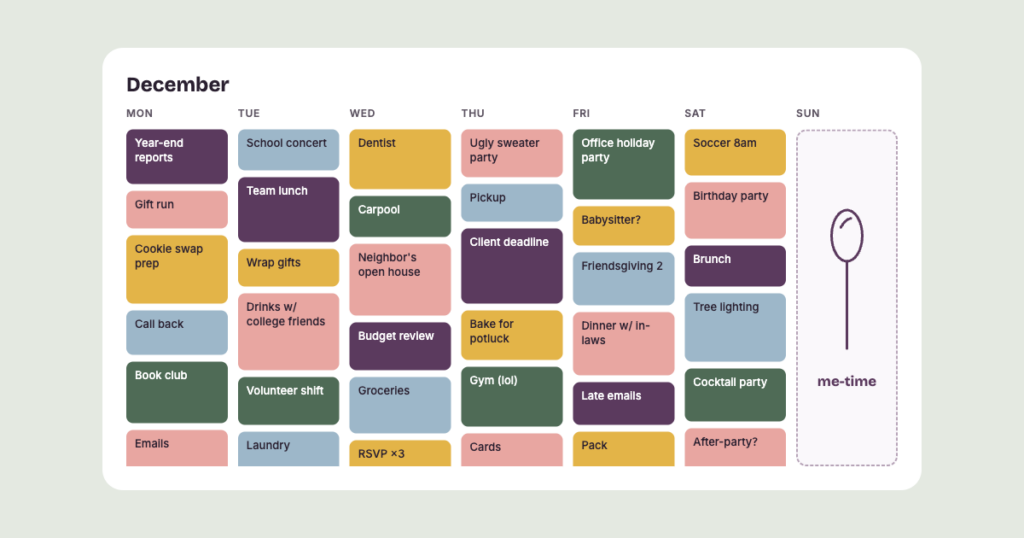
Are you an overscheduler? Life is busy, and in a world that seems to reward chronic fatigue, it can be all too easy to say yes to everything before you realize you’ve maxed out your social battery. One day you’re fielding emails and texts, and the next you look down at your calendar and think, “What have I done?”
As the holiday season approaches, the risk of social burnout reaches a fever pitch. If this cycle sounds all too familiar, it might be a sign to take a breath, put down the phone, and just say “no.”
People overschedule for a variety of reasons. Perhaps you have been a people-pleaser for as long as you can remember. The thought of disappointing others can be physically uncomfortable and deeply upsetting. Maybe you struggle with organizing your activities and genuinely feel great saying yes when the invites roll in, but aren’t considering the cumulative impact of multiple plans in a short period of time. Or you might be entering a different season of life, and what once felt fulfilling now feels draining in the context of competing demands.
If you read any of those and think, “I’m the problem, it’s me,” here are a few strategies to help you keep calm and protect your time:
- Centralize your calendar: Organize your schedule in one central location. Having multiple lists and schedules is a recipe for overcommitment.
- Practice the pause: When you get an invite, normalize saying, “Let me check my calendar and get back to you.” Resisting the urgency can help you practice mindfulness in what you choose to take on. When you check your calendar, don’t just check the one day or time block. Check the whole week. See what you’ve already committed to. Come up with a number of activities you can handle per week, and if you’re at your max, adopt a one-in, one-out model. If you say yes to the new invite, it means cancelling one of the other plans.
- Embrace the discomfort: You cannot be all things to all people, as much as you might want to be. If you need to say no to someone, remember that it is in service of staying grounded, present, and counter-intuitively fostering that relationship. If you show up to plans you don’t actually want to be at or say yes now but ghost later, it does serious damage to the quality of your relationships. Allowing yourself to feel the discomfort of disappointing someone could be the thing that strengthens your relationships most of all.
- Do a values sort: If you are unsure how to prioritize (Work! Family time! Exercise! Friends! How can a person decide?), try doing a values sort (President and Fellows of Harvard College and Project Zero, n.d.). Values can act as our north star, guiding our actions on a daily basis. Values also shift over time, and what was once important to you might have changed. Clarifying your values every so often can help you make sure you are dedicating your time and energy to the people and activities that matter most to you now.
- Schedule me-time: Put in days, nights, or blocks of time committed to YOU and your self-care activities. Honor your commitments to yourself as much as you likely honor your commitments to others. Showing up for yourself strengthens an important muscle and ensures you have the energy to be there when others need or want to share time with you too.
- Reject the hustle: Remember: exhaustion is not a badge of honor. We’re all familiar with the game of “who does more.” The truth is, once you’re playing that game, you’ve already lost. The people you spend your time with would much prefer to get your rested, best self versus the frazzled version of you who laments over lost nights of sleep or how long your to-do list is. It is not your fault that life is so busy, and you just might have more ability to push back on the overscheduled, overbooked, overcommitted lifestyle than you think.
- Honor your spoons: Because everyone’s social battery is wired differently, your limits won’t look like anyone else’s. If you’re familiar with The Spoon Theory (Miserandino, 2017), you know that Miserandino coined the theory while sitting in a diner with a friend who asked what it was physically and emotionally like to live with lupus. To explain her daily reality, she grabbed every spoon on the table, handed them to her friend, and explained that these represented her energy units for the day. We don’t all start with the same number of spoons, and once you’re out, you’re out for the day. Pretending you have more than you do won’t stop you from running out. Invite yourself to be honest with yourself and honor your needs… or spoons.
- Talk to your therapist: Talk to your therapist about these patterns, as they are often rooted in core beliefs that show up across multiple areas of your life; if you’re interested in starting therapy, reach out to Wildflower to schedule. Breaking these cycles is hard, and you don’t have to do it alone.
References
Miserandino, C. (2017). The spoon theory. In Beginning with Disability (pp. 169–172). Routledge.
President and Fellows of Harvard College and Project Zero. (n.d.). Value sort. The Good Project. Retrieved November 11, 2026, from https://www.thegoodproject.org/value-sort