

Have you ever known what you needed to do before you could fully explain why? Some people call this a “gut instinct,” others intuition, an inner voice, or simply a sense of knowing. There have been plenty of times when listening to my gut has served me well, and other times when my gut has been completely wrong.
That’s because not everything that feels like intuition is wisdom. “Trusting our gut” can sometimes look more like the urgent pursuit of certainty (read: anxiety), the pull of an intense emotion, or a familiar reaction shaped by past experience. These signals can be powerful and important, but they aren’t necessarily wise.
There is another kind of knowing that tends to be quieter. It makes room for what we feel without being ruled by it, while also taking into account what we know: the facts, the context, our experience, and what matters most to us. It involves the head, the heart, and perhaps something even deeper.
What Is Wise Mind?
In Dialectical Behavior Therapy (DBT), this is what Marsha Linehan calls Wise Mind.
Wise Mind allows us to listen to our intuition without automatically obeying it. Wisdom is not about choosing between your head and your heart. It is about learning to hear both clearly enough to respond to the whole situation.
Linehan’s model describes three states of mind: Emotion Mind, Reasonable Mind, and Wise Mind. None is inherently good or bad. Each gives us access to important information, and each can be highly effective depending on what the moment calls for. Understanding Emotion Mind and Reasonable Mind helps us understand what makes Wise Mind distinct.
The Three States of Mind
Emotion Mind: What am I feeling? What does my emotional experience tell me?
Reasonable Mind: What do I know? What are the observable facts?
Wise Mind: Taking all of this into account, what do I know?
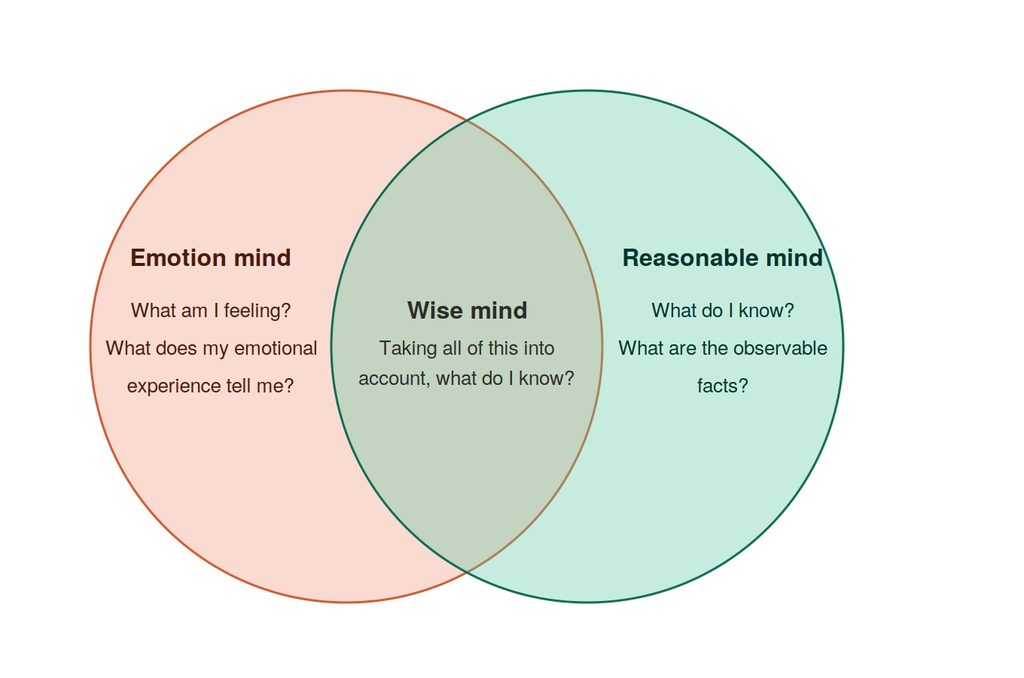
To be clear, Wise Mind is not simply a negotiation between Emotion Mind and Reasonable Mind. We don’t tally up the evidence from each side and see which one wins. Wise Mind involves integration, a felt sense of knowing that emerges when we are willing to remain in contact with both our internal experience and the reality in front of us. It incorporates what we feel, what we know, what we have learned through experience, and what matters to us.
Sometimes the wisest response will look quite emotional. Sometimes it will look remarkably rational. And sometimes it will surprise us altogether.
What Wise Mind Looks Like
Wise Mind is often:
- quiet rather than urgent
- grounded rather than certain
- responsive rather than reactive
- flexible rather than rigid
- values-oriented rather than immediately gratifying.
We sometimes imagine wisdom as a state of perfect equanimity: calm body, clear thoughts, no competing feelings. But Wise Mind does not require emotional neutrality. You may still have a racing heart, be angry, or desperately wish reality were different. Accessing Wise Mind doesn’t mean eliminating those experiences; it means making room for them without handing them sole responsibility for what happens next.
Wise Mind is seeing both the forest and the trees. Emotion Mind may zoom tightly into one tree. Reasonable Mind may study the map of the forest. Wise Mind can hold both perspectives and ask, Where am I actually trying to go?
What gets in the way of Wise Mind? Often, it is urgency, the feeling that we need to figure something out now. Other times, it is our yearning for certainty: the need to know that we are making the “right” decision before we make it. But many of life’s most difficult decisions don’t offer that kind of guarantee. Acting faster doesn’t necessarily make us more certain, and thinking longer doesn’t necessarily reveal a perfect answer. Wise Mind helps us tolerate not knowing everything about a situation. Sometimes wisdom is not knowing the answer. It is knowing the next step.
Do We Always Need to Be in Wise Mind?
Not necessarily. And not in the way we sometimes think.
There are moments when allowing ourselves to fully experience emotion is enormously valuable: falling in love, grieving, playing with your child, creating art, celebrating, or simply allowing yourself to feel. There are also moments when Reasonable Mind is exactly what the situation requires: calculating a budget, following emergency instructions, assembling furniture, or interpreting data.
The goal isn’t to monitor ourselves constantly or treat Emotion Mind and Reasonable Mind as states we need to escape. It’s to become increasingly able to recognize our state of mind and increasingly able to access our own wisdom when we need it.
The Role of Mindfulness
This is where mindfulness comes in. Wise Mind doesn’t always arrive slowly. Sometimes we know almost immediately. But when emotions are intense, deliberately slowing the process can help us distinguish wisdom from urgency. A pause creates just enough space between what we experience and what we do next.
We aren’t slowing down simply for the sake of being calm. We are slowing down so that we can notice more.
And when we notice more, more becomes available to us: our feelings. The facts. Our body’s signals. Memories of past experiences. Potential consequences. Alternative perspectives. Our values. Choice.
Practicing Wise Mind
The Three Voices Exercise
Think of a decision you’re wrestling with and write three responses:
Emotion Mind:
What am I feeling?
What do I want?
What is my urge to do?
Reasonable Mind:
What are the facts?
What are the likely consequences?
What would an objective observer notice?
Wise Mind:
Knowing all of that, what feels true?
What response fits both reality and the person I want to be?
Resist the urge to write the Wise Mind answers immediately. Instead, pause. Breathe. Walk away for five minutes. Then return.
Learning Your Wise Mind Signature
Think back to two or three times when, in retrospect, you believe you acted from Wise Mind.
Ask yourself:
What did I notice in my body?
How did my thoughts sound?
Was there urgency or spaciousness?
Did I feel certain—or simply clear enough?
What helped me get there?
What did I do next?
How is this different from what urgency feels like in me?
Head • Heart • Intuition
Ask the same question three times:
Head: What do I think?
Heart: What do I feel?
Gut: What is my intuition telling me?
Values: Who do I want to be in this situation?
Wise Mind: Taking all of this into account, what do I know?
The Body Vote
Before deciding, imagine yourself choosing Option A. Don’t analyze it. Notice what happens physically.
Then imagine choosing Option B.
Where is there constriction? Relief? Energy? Heaviness? Openness? Fear?
Our bodies offer information, not instructions. Don’t assume the more comfortable option is the wise one.
Ask:
Is this discomfort telling me “this isn’t right,” or is it telling me “this is difficult”?
Wise Mind doesn’t always lead toward comfort.
The Forest-and-Trees Exercise
Draw two columns:
THE TREES
What’s happening right now?
What am I feeling?
What needs my attention?
What details matter?
THE FOREST
What is the larger pattern?
What will matter six months from now?
What are my values?
What kind of relationship/life/person am I trying to build?
Then:
WISE MIND:
What response honors both?
Wise Mind Doesn’t Always Feel Certain
Wise Mind often whispers while urgency shouts. But not always.
Wise Mind can tell us: Get out. Say no. Act now. The difference isn’t simply volume. Urgency often demands immediate action in order to make an uncomfortable internal experience stop. Wise Mind asks what the situation actually requires even when the answer is uncomfortable.
Someone might initially believe:
“I KNOW I need to let my daughter quit soccer today.”
But slowing down might reveal something more nuanced.
Emotion Mind: I can’t stand watching her come home defeated after every practice. I want to protect her from that feeling right now.
Reasonable Mind: She’s only been on the team for three weeks. Quitting every time something is hard could become a pattern, and she hasn’t given herself a real chance to improve.
Wise Mind: Something about this really does need attention: her confidence or maybe the fit with this particular team. I don’t have to decide today whether she’s done with soccer forever. I can sit with her, understand what’s actually hard, and give this a little more time before deciding anything permanent.
Importantly, Wise Mind isn’t always the middle path. In another situation, the wisest response might actually be: She needs to stop right now. This isn’t building resilience, it’s breaking something in her. Integration doesn’t necessarily produce moderation; it produces a response that takes the whole situation into account.
Wise Mind does not promise certainty. We often make the wisest decision available to us with the information, experience, and perspective we have at a particular moment, and then life gives us new information. Wisdom includes our ability to respond to that, too.
We can reconsider; change course; discover that something that was right for us six months ago is no longer right today. We can make a thoughtful decision and still experience an outcome we didn’t want. None of this necessarily means that we failed to access Wise Mind.
In fact, one of the gifts of Wise Mind may be that it allows us to hold our decisions a little less tightly. Instead of remaining preoccupied with Was I right?, we can stay curious: What is true now? What has changed? What matters here?
Wise Mind is not a destination we finally reach or a voice we learn to obey perfectly. It is a practice of returning to our emotions, to reality, to our values, and to ourselves.
The practice isn’t about always getting it right. It’s about continuing to ask: What is wise now?