
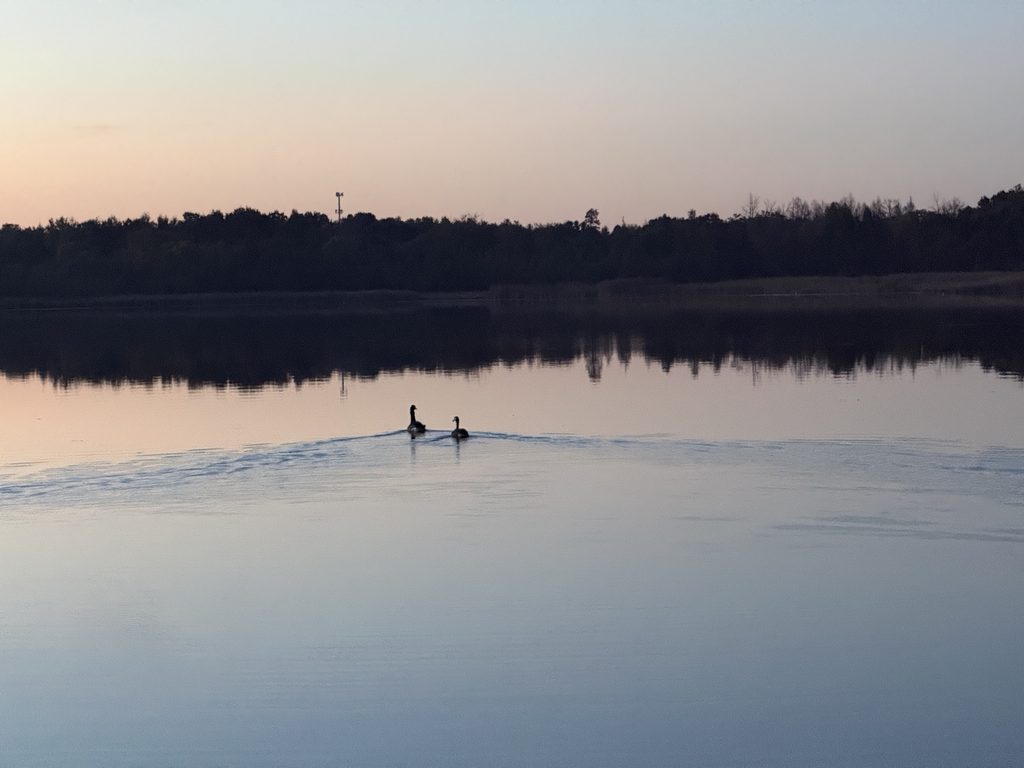
This past weekend I went camping. On the first evening, after the tent was up and the sun had gradually slipped behind the horizon, I sat at the edge of a calm lake and watched two geese move across the water. They weren’t in a hurry. They swam forward, paused, drifted for a while, swam again. Two long trails opened on the surface behind them and dissolved in the fading light. The pace they moved at felt natural. It felt right.
I watched and watched, and couldn’t get enough of how present they seemed, how at home with everything around them. I kept wondering: if I gave myself permission to move more slowly, what might I start to notice? What would it be like to simply not rush?
A season that asks us to slow down
Fall, I think, is a gentle invitation to do exactly that. The light is still warm but less intense, the evenings arrive earlier, and in losing their leaves, even trees remind us that it is okay to let go. The very air feels like it’s asking us to pause.
Many of us need that invitation more than we realize. I know I do. Summer has its own kind of busy, even when it’s the fun kind: trips, weddings, long light, weekends so full we come home wishing we had another weekend to recover. Then September arrives, and for parents the pace shifts again. New schedules, school forms, early alarms, the scramble out the door, pickups and practices, and the constant background math of who needs to be where, and when. Somewhere in all of that, slowing down stops feeling like an option. Yet it’s desperately needed.
Fall offers us a reminder that having our foot constantly on the gas pedal does not need to be the way we spend our lives. However, in order to slow down, we would first need to give ourselves permission to consider the possibility of a different pace. To imagine it. Often at this juncture people say, “But there is no way! Have you seen my to-do list?”
I get it. I know how impossible slowing down can feel when so much needs to be done. But consider this: that frantic feeling, that frustrated “I have to get this done! I’m so busy!” is a sign that your nervous system is overloaded; it’s trying to keep up while operating in a fight-flight-freeze space, where everything is a threat, and rest and relaxation feel impossible. This is not sustainable.
The window of tolerance
Psychiatrist Dan Siegel introduced the idea of the window of tolerance in 1999 to describe the zone where we function best in our everyday life. Inside that window, we can feel what we feel without being swept away by it. We think clearly, stay connected to the people around us, and meet stress with some flexibility. We’ve written about it on the Wildflower blog here.
When we get pushed above the window, we land in hyperarousal: racing thoughts, irritability, anxiety, that wired feeling where everything is urgent. Sounds familiar? That’s often where the endless to-do list lives. Below the window is hypoarousal, which looks more like numbness, fog, exhaustion, going through the motions. Everyone moves in and out of the window as we navigate life. Often though we can find ourselves spending weeks, or a whole season, mostly outside of it. Maybe we rationalize this, believing that is just how life is and that nothing can be done about it.
It’s painful to be outside the window of tolerance. Small things set us off, or we go quiet and checked out. When we’re outside the window, we actually get less done (it’s hard to be efficient when overwhelmed), and we certainly enjoy less of what we do. The encouraging news is that the window can widen again. It responds to rest, to safety, to the kind of unhurried presence embodied by the geese I mentioned earlier.
We belong to nature, too
Our bodies belong to the natural world more than we usually remember, and they tend to follow its lead when we let them. We can take the cue from the fall season. Importantly, we won’t get back into the window by thinking our way back to it. We’ll be more likely to find our way back through the body, the senses, intentional slowing down, and giving ourselves permission to savor and experience small pleasures. Fall is generous in creating opportunities to do just that. Why not try?
Simple practices for a slower season
Walk slowly, on purpose. Try half your usual pace and see what you start to notice: the crunch underfoot, the smell of damp leaves, cool air on your face. When your mind drifts to tomorrow’s to-do list, bring your attention back to your feet.
Collect acorns. Or chestnuts, or pinecones, whatever your corner of the world offers. There’s something settling about looking down, searching, bending, filling a pocket. Children do this without being told. Adults mostly forget they’re allowed to.
Make something small with your hands. When I was a kid, fall meant making little people out of chestnuts and acorns, toothpicks for arms and legs, acorn caps for hats. I could lose a whole afternoon to it. If you’d like to try, with kids or on your own, here is s a lovely walkthrough of chestnut creatures.
Gather leaves and dry them. Pick the ones that stop you, the reddest maple, a perfectly yellow ginkgo, and press them between heavy books for a week or two. Just a small delight.
Linger at a coffee shop. Order something warm and leave the laptop at home (that part is important!). Stay a little longer than you planned. Hold the cup with both hands and watch people pass by. Lingering has become almost a lost art, and a tired nervous system is grateful for it.
Sit near water. A lake, a river, the pond at your local park. Water keeps its own time, and watching it has a way of slowing us down.
Let the evenings get cozy. A blanket, a candle, soup on the stove, the lights dimmed a little earlier. Small comforts like these tell the body, quietly, that it’s safe to settle.
An invitation, not another task
It would be easy to turn all of this into one more list to get through. Please don’t. The to-do list has enough on it already. Choose one thing, maybe two, and let the rest be.
This fall, I’d like to give myself that same permission, and I hope you’ll give it to yourself too: slower walks, pockets full of acorns, steaming soup, and a nervous system that is grateful for a bit of reprieve.
Also, know this: If you’ve been outside your window of tolerance and struggling to find your way back, our therapists at Wildflower are here for you.