
Recently there has been a growing discussion and acceptance of neurodivergence, leading to an increase in the number of people who identify with the label “autistic”. The mental health community has some history of being unwelcoming or outright hostile to autistic communities, creating unsafe environments or mislabeling certain behaviors. Many practitioners are unsure of how to interact with autistic individuals or adequately treat their symptoms which can lead to autistic people not getting the needed care.
As an autistic clinician myself, and as someone trained to work with autistic individuals, I want to shine a light on both the work that I do and my experience as a client. I am speaking as a relatively privileged autistic person (I am speaking, I have low support needs, and I mask well). There are experiences of the disorder that I cannot present here because I am not as aware of them.
I also speak from my experience working with autistic individuals for the past 5 years, and as someone who trained as an Autism Spectrum Disorder Clinical Specialist in 2023. Through these experiences I have learned a lot about what makes an affirming space for certain autistic clients, and how we can be best supported throughout the therapeutic process. Lastly, this article may be helpful to autistic clients seeking care who need a guide on what to look for in a clinician.
Ask to Understand
Some clients are coming into therapy for the first time, with limited knowledge of their needs as an autistic person. Some clients may be coming in with a long list of needs and expectations related to their autism diagnosis. It is important for us as clinicians to listen in order to understand where the client is at, and what aspects of their neurodivergent experience is most salient to them.
Language we use is particularly important. For instance, you may have noticed that I use the term “autistic person” to describe people with autism. This is my preference as an autistic person in how I communicate. People may be more accustomed to or prefer that you use the phrase “people with autism” or “people with autism spectrum disorder”. This is an individual preference that people may or may not have. Without asking questions such as “Do you prefer person-first language?” you could offend or upset someone without intention.
This extends to the goals and objectives that a client is coming in with. Some clients may have a clear understanding of their sensory issues that they choose to work on, or the meltdowns that they experience at work. Others may need help identifying what specifically is happening in those instances and how an unaccommodating environment might be contributing to a negative experience.
As a client, feel free to ask as many questions as you need. The right therapist should be able to listen and create space for your curiosity.
Clarity in Goals, Objectives, and Boundaries
It is vital in all client interactions to create clear boundaries. With autistic clients this might mean communicating more about the boundaries of the space, or having it in writing for the clients review. Always ask the client what they need, but be prepared to potentially create more clarity than normal.
Clients might also benefit from clear structure or a clear understanding of the objectives that plan to be achieved throughout therapy. I always spend ample time in treatment planning sessions explaining exactly what modalities we will be using, what the purpose of that modality is, and how it will enable the client to reach their goals. By doing this I make it clear that there will be no surprises in the therapy space.
This attends to the client’s nervous system as well as the desire for clear structure and expectation that many autistic people have.
Understanding the Nervous System
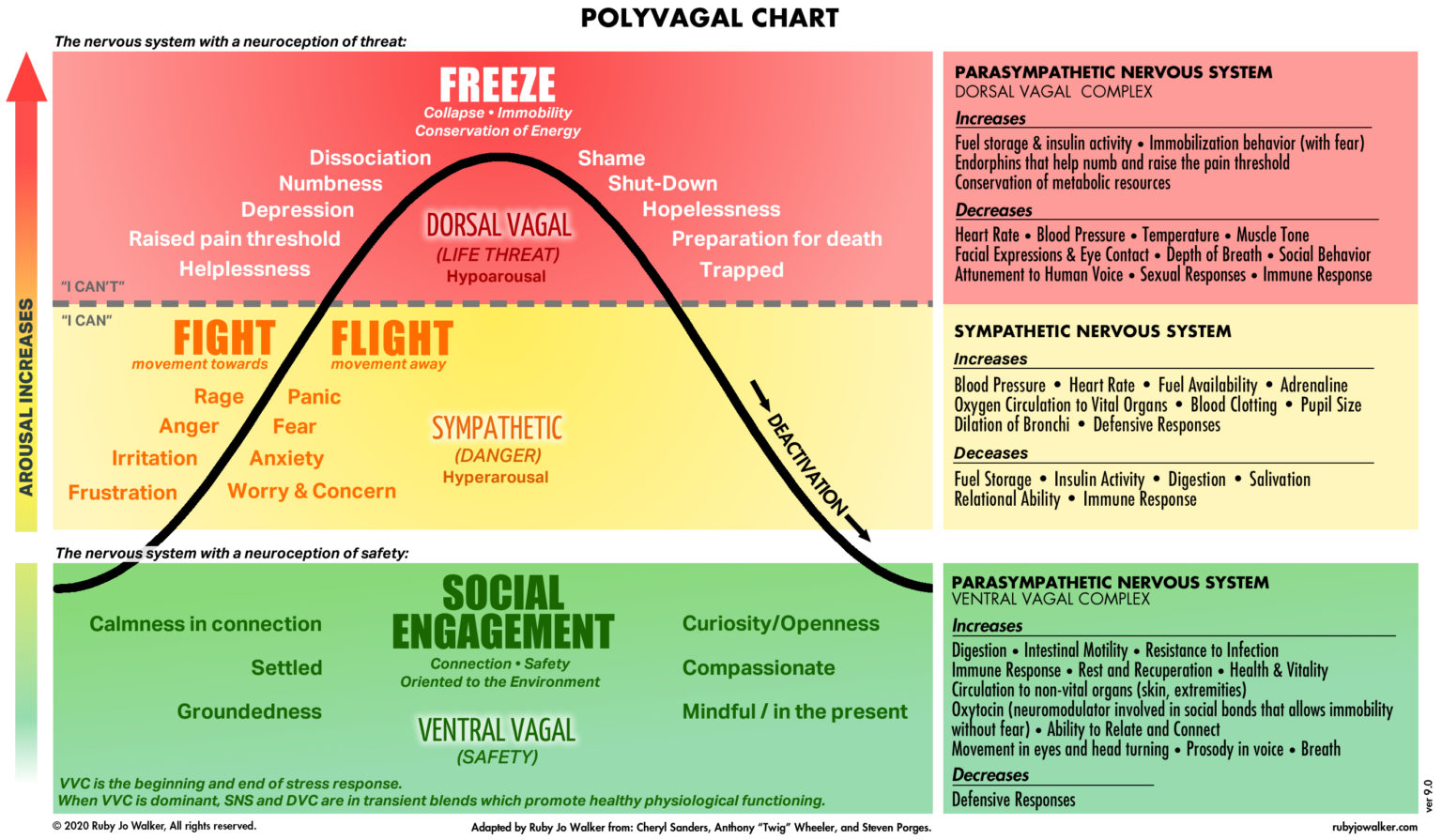
The first thing I show a new client with autism is a polyvagal chart. By showing them this chart I am attempting to connect their experience of the outside world with their experience of internal turmoil. It can be extremely affirming to see that your meltdowns or heightened responses are the result of real bodily experience and not just “in your head.”
At times autistic people can feel cut off from the experience of the body, an experience called alexithymia. This experience makes it difficult to listen to the body’s cues enough to respond and act appropriately when a situation feels heightened. Through understanding the nervous system and working to integrate that understanding into everyday life, this awareness can come back. This also gives clients a sense of agency and control over their experience as they can now accept and respond to their body’s cues.
Understanding how their nervous system system and learning what calms someone can take time. In my experience, somatic coping tools, DBT TIPP skills, and mindfulness have all improved clients ability to make sense of and respond to their nervous system. We might also spend time mapping the different parts of nervous system response and finding where the client responds best to intervention. What is your experience of your body when you are in fight or flight? What about at rest?
These questions can assist the client in understanding their own capacity and room for attention at any given moment.
Monotropism and Attention
Autistic people are monotropic, which means that we excel more at focusing on a small amount of interests deeply rather than a large distribution of attention on multiple things. This kind of focus can actually be really great for therapy because clients might be more able to focus on the topics at hand when they are stimulated by them and the information is clear.
Understanding montropism can assist in creating more meaningful sessions that allow clients to fully understand and process what is being asked of them. Throughout a session I appreciate when my therapist slows down the process and allows me to fully understand the connections being made or the specific modality being used. I think it is also important to be honest when a session has lost my attention or when some other sensory input is creating barriers to my attention.
Monotropism contributes to autistic people’s capacity for special interest. Creating rapport with a client might mean allowing them to spend time telling you about their collection of dolls, or the meaningfulness of a certain animated property. These moments are quite vital to the relationship even if they may not seem perfectly appropriate to whatever is being worked on in therapy. But perhaps the plot of Encanto actually is a chance to talk about family dynamics!
Sensory Needs are Paramount
It is important to understand how sensory experiences are influenced by monotropism. That annoying sound really might make it impossible to speak, leading to frustration or overwhelm. I recall working with a client who was struggling a lot with a sense of anxiety in their personal space – until we were able to get them a dimmable light for their room. I often will ask clients what their sensory load is coming into the session, and see if there is anything they need to change about the environment before we can start. A switch to headphones or a change in body position really can make all the difference!
We can understand social demands as sensory input as well. It is difficult to keep track of multiple people in a conversation because it is asking a lot of our sensory processing. This then can impact the nervous system, and lead to the need for down-regulation activities. Clients may need a slower ramp up into therapeutic activities or they may seek out social interaction that involves one person instead of multiple. I went to a Drag Show the other week, and while I was able to have fun, I struggled to hold conversations with my group because there was already so much sound in the room. In order to recover from the experience the next day I had a solitary, low-expectation day.
In order to feel calm in the body some autistic people need to stim. This can include fidgeting, moving around, or verbalizing in some way. Allowing stimming in your therapy space can make an autistic person more comfortable, and encouraging various types of stimming has created strong rapport in many of my therapeutic relationships.
Conclusion
Whether you are an autistic client or a well-meaning therapist, understanding the intricacies of autistic needs in the therapy space can benefit you. Having a therapist who can relate to the way you communicate or experience sensory differences can be vital to your healing. Through understanding some of the concepts above I hope that therapists feel more prepared, and clients feel more comfortable to advocate for their needs.
If you are in search of a neurodivergent affirming therapist, Wildflower may have the right clinician for you!
Citations
Bennie, M. (2022, October 6). What is a structured environment? why is it helpful for autistic individuals?. Autism Awareness. https://autismawarenesscentre.com/what-is-a-structured-environment-why-is-it-helpful-for-autistic-individuals/
Clarke, G. (2023, December 29). The Importance of “Person-Centered” Language. ALSO. https://alsoweb.org/the-importance-of-person-centered-language/
Edgar, H., & Adkin, T. (2025, September 4). What is Monotropism? Understanding a neuroaffirming theory of autism. National Autistic Society. https://www.autism.org.uk/learn/knowledge-hub/professional-practice/what-is-monotropism
Jones, S. (2024). The Autistic Survival Guide to Therapy. Jessica Kingsley Publishers
Kinnaird, E., Stewart, C., & Tchanturia, K. (2019). Investigating alexithymia in autism: A systematic review and meta-analysis. European psychiatry : the journal of the Association of European Psychiatrists, 55, 80–89. https://doi.org/10.1016/j.eurpsy.2018.09.004
Lipinski, S., Boegl, K., Blanke, E. S., Suenkel, U., & Dziobek, I. (2021). A blind spot in mental healthcare? Psychotherapists lack education and expertise for the support of adults on the autism spectrum. Autism, 26(6), 1509-1521. https://doi.org/10.1177/13623613211057973
Marsh, E. (2025, September 30). Monotropism: Understanding autistic ways of being through the lens of attention. Reframing Autism. https://reframingautism.org.au/monotropism-understanding-autistic-ways-of-being-through-the-lens-of-attention/
Monotropism, an autistic theory of autism. Monotropism. (2026, July 29). https://monotropism.org/
Pickard, H., Hirsch, C., Simonoff, E., & Happé, F. (2020). Exploring the cognitive, emotional and sensory correlates of social anxiety in autistic and neurotypical adolescents. Journal of child psychology and psychiatry, and allied disciplines, 61(12), 1317–1327. https://doi.org/10.1111/jcpp.13214
Swann, R. (Ed.). (2025, June 6). Is there an autism epidemic?. Johns Hopkins. https://publichealth.jhu.edu/2025/is-there-an-autism-epidemic