
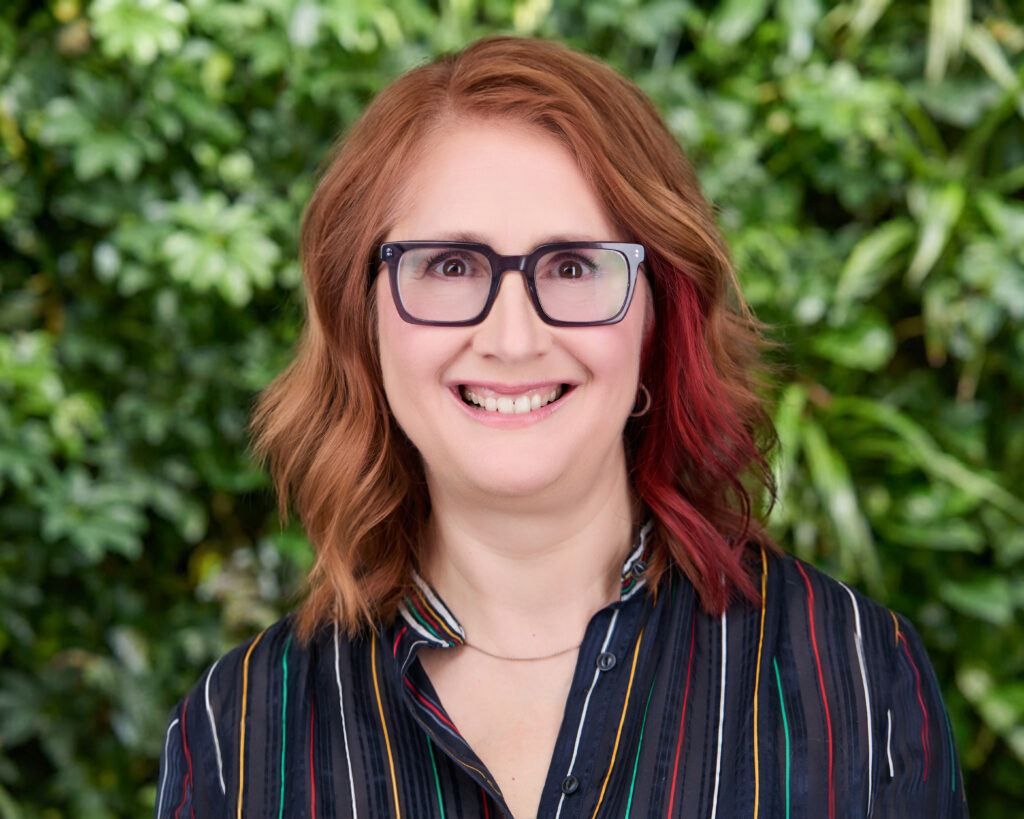
Tawnya Blanford (she/her) is a psychotherapist at Wildflower. In her clinical practice, Tawnya draws from evidence-based modalities including Parent Child Interaction Therapy, Parent Child Interaction Therapy with Toddlers, and Child Parent Psychotherapy. Her therapy is based on Psychodynamic Theory, Attachment Theory, Strengths-Based Therapy, Cognitive Behavioral Theory, Social Learning Theory, and Developmental Approaches. Tawnya works with adults, couples, and families experiencing the transition to parenthood, challenges with parenting, early childhood difficulties, perinatal mood and anxiety disorders, trauma, grief, other mental health concerns, developmental challenges, neurodivergence (including the spectrums of Autism and ADHD as well as sensory needs), and relationship issues. Tawnya has experience in supporting the relationship between parents and their infants, toddlers, and young children. She obtained her master’s degree at Aurora University in Social Work with a specialization in children and families. Read Tawnya’s full bio here.
What inspired you to pursue a career as a psychotherapist?
I was inspired by the power of the therapeutic relationship to heal hurts and support personal growth.
As a psychotherapist, what part of your job is most satisfying?
I value times of deep connection, when someone trusts me with the depth of how they are feeling and with the reality of their experience. Making connections between what is happening and why can be very powerful, as when a parent recognizes that their infant’s cries that are so hard to hear are reminding them of a period of deep sadness in their own life.
How would you describe your therapeutic approach?
My approach is relationship-based, in that I focus on how I am connecting with someone(s) and how I am being responsive to what each individual brings into the therapy space – and in that I am curious about relationships including the relationships carried within each person and the dynamics of current interpersonal relationships. I approach therapy psychodynamically, in that I believe that there is meaning to someone’s symptoms, behaviors, and challenges. I explore meaning not just in individual personality and internal experience but also in personal history – including early relationships and experiences as well as intergenerational history and patterns. I also utilize cognitive behavioral, social learning, and developmental approaches – which may include coaching and guidance as well as reflection and problem solving about interventions to address internal and interpersonal challenges. I help those I work with seek sources of resilience and hope by recognizing internal strengths, community and cultural sources of strength, and supportive relationships.
Why do you believe that psychotherapy can help?
We are all developing. How we engage in relationships and in the world impacts how our brain and body work together not just for young children but also as we age. There is always an opportunity for growing self- awareness, self-compassion, self-regulation, and mindful insight and responsiveness in relationship with others. We are motivated toward growth because we want to be happy and connected – and wish for the well-being of those around us. Psychotherapy is a special opportunity to work toward our goals with the support of a trusted guide and companion.
What are some of your specialties and what drew you to them?
I am especially drawn to working with people during and following the transition to parenting. We all have our earliest relationships inside of us, impacting who we are and how we relate to others and to the world around us. The transition to parenthood is a time of upheaval when a network of support is essential — and when there is an opportunity for growth. I love supporting parents in finding self-compassion and support and in relating to their children in ways that are working toward their dreams for their children and for their family.
Child Parent Psychotherapy is a way of being deeply present with parents and young children and of helping parents to trust their children to “tell” them through interaction, play, behavior, and words what their children are feeling and why. I am drawn to helping parents “listen” and communicate understanding, nurturance, benevolence, and safety to their children.
Parent Child Interaction Therapy (PCIT) is a way of directly coaching parents on connecting with their children, increasing positive interaction and behavior, and following through in response to challenging behavior. I was drawn to PCIT because parents were seeking more answers about just what to do in response to challenging behavior, and because there is research and evidence that PCIT works!
Parent Child Interaction Therapy for Toddlers (PCIT-T) adapts PCIT to the developmental needs of very young children. I was drawn to getting certified in PCIT-T because the program IS developmental, supporting the social and emotional development of young children through positive interaction and through teaching young children that responding positively in interaction with others feels good! The model was also developed with awareness of each family’s experience in terms of their history and culture, with the therapist encouraged to work with families to implement strategies in a way that fits and works toward this family’s goals. I also like how PCIT-T also focuses on emotions, such as encouraging parents to name their toddler’s emotions and providing specific ways for parents to regulate themselves and to help their young children to calm down.
What is one thing about psychotherapy you wish everyone knew?
I wish that there was less of a stigma, or a feeling that psychotherapy is for people who have messed up or who are doing something wrong. As a developmental, psychodynamic psychotherapist, I know that we can all benefit from better understanding ourselves and our relationships with others, and by having someone by our side as we work toward our goals for ourselves.
What is your motto or personal mantra?
I remember in my late childhood telling myself, “Smile and the world will smile with you,” and I still seem to follow this principle!
My grandmother always told all of her grandchildren, “I just want you to be happy” – which inspires me to follow my heart and encourage others to do the same.
What are your favorite self-care activities?
I love dancing, which is my favorite work-out. I’m always happy hanging out, walking, or playing with my dogs! And there’s something to be said for letting ourselves “do nothing” sometimes – which for me might include ringing a singing bowl, looking outside at nature, or just letting my mind wander!
Other thoughts?
I believe that we all hold inner wisdom as well as the wisdom of those who have come before us. Tuning in to ourselves, practicing mindfulness, and hearing and learning stories from our family and our people can guide us.