

Why Explore Somatic Therapy?
When you think of “therapy,” the image of two people sitting across from each other holding mugs of tea might come to mind. And that image would not be wrong and, in fact, the process of talking through one’s problems can be exceptionally healing. But we all know emotions and memories are not just stored in the brain. While a “top down” approach to therapy can help you cognitively understand and process past experiences, you might find that the healing leaves something to be desired.
Somatic therapy is a mysterious way of describing several types of therapies that involve the body or provide a “bottom up” approach. Simply put, this umbrella term captures modes of healing that engage the body first, regulate the nervous system, and work on distressing feelings, experiences, and sensations stored in places the prefrontal cortex can’t reach.
Even if you are on board with that concept, expanding the idea of what therapy “should be” is challenging. We have conscious and unconscious biases that encourage us to stay true to the image of laying on a couch and telling a stranger your life’s story and deep rooted anxieties.

It’s fair if you are skeptical about “somatic therapy” and if it can actually do anything to help you heal. You might find yourself thinking: “What even IS a somatic approach anyway?” “Does it involve physical contact?” “Can’t I just go get a massage?” “Should I go take a yoga class instead of therapy then?”
And while massage, Reiki, yoga classes and other forms of physical activity might be incredibly helpful and recommended as adjunctive forms of embodiment and self care, they are not in and of themselves a form of somatic therapy provided by a licensed mental health professional.
This article will seek to clarify what somatic therapy is, why it is helpful, and give you information to help determine if it is right for you.
What Is Somatic Therapy, Really?
Somatic therapy has its roots in the understanding that the mind and body are interconnected, a concept that dates back to early body-oriented psychology pioneers such as Wilhelm Reich, Alexander Lowen, and Thomas Hanna who emphasized how emotional experiences are stored and expressed physically. Modern somatic approaches build on this foundation through neuroscience and trauma research, particularly the work of Bessel van der Kolk (author of The Body Keeps the Score), Peter Levine (Somatic Experiencing), and Pat Ogden (Sensorimotor Psychotherapy) which show how trauma is held in the body’s nervous system rather than solely in cognitive memory. These therapies integrate body awareness, movement, and regulation techniques to help clients process and release trauma. Grounded in polyvagal theory (Stephen Porges), somatic therapy emphasizes restoring safety and connection through nervous system regulation. Polyvagal theory and somatic therapies help people “work with (their) nervous system to foster balance, presence, and a deeper understanding of (themselves). Ultimately, it bridges psychology, physiology, and mindfulness to promote healing that is both embodied and emotional (Cobb, 2025).
What these clinicians have all worked to highlight is that unresolved emotions and trauma can “live” in the body. During an adverse experience, your body—more specifically your nervous system—responds automatically to keep you safe. We know about these states as flight, fright, freeze and submit. Those automatic responses aren’t the problem, in fact when we’re in danger they’re the solution. What becomes problematic is when we get stuck in one or more of those states for a prolonged time.
Furthermore, the memories of these experiences are not stored in the pre-frontal cortex where we store rational thought that can be accessed in “top-down” therapeutic approaches. The visceral experience of fight, flight, freeze, or submit are stored in the body, so when those memories are triggered we feel them in the body, possibly without conscious awareness that a memory was even triggered at all. It makes sense then, that healing would need to start where these memories are stored: the body.

Common Myths & Misunderstandings
If you are familiar with somatic therapy, you might still believe some of the most common myths about this approach.
Myth: It’s only for trauma survivors.
Truth: Somatic interventions are wonderful for helping trauma survivors reintegrate and heal trauma related symptoms. They are also beneficial for stress, anxiety, boundaries, resilience, and everyday emotional regulation.
Myth: It’s just breathing exercises or stretching.
Truth: Breath work and movement are key aspects to somatic therapies. That being said, techniques go deeper (tracking sensations, grounding, movement, activating mirror neurons to deepen connection, and more).
Myth: It’s too “woo-woo.”
Truth: Somatic therapies are backed by neuroscience and research on nervous system regulation. Somatic therapy approaches are evidence-based therapeutic modalities.
What Does a Somatic Session Look Like?
In general, somatic therapy will involve gentle exploration in which the therapist may guide the client to notice sensations, posture, and breath. For example, they might say “When you talk about your stressful work meeting, what do you notice in your chest or shoulders?” And introduce grounding skills, breathwork, guided imagery, mindful movement, and titration (small steps to process big feelings) to support the client in addressing the emotion in the body.
There is also an emphasis on collaboration and choice. The therapist might guide the interventions, but the client stays in control. Afterall, they are the only one in their body and therefore the only one who can know what they are feeling and what is offering relief.
Somatic therapy is an overarching approach to therapy, and under that umbrella there are specific, evidence-based modalities, including but not limited to:
Eye Movement Desensitization and Reprocessing (EMDR)
Trauma Sensitive Yoga Therapy (TSY)
The Science Behind Somatic Therapy
As we’ve covered, this is a scientifically based type of therapy. The key points to remember are:
- Polyvagal theory: Understanding safety and connection and how the nervous system plays a role in these experiences
- Implicit memory: Emotions and memories live in the body
- Neuroplasticity: The brain and the body can learn new patterns. Brain mapping studies show that the parts of the brain most affected by trauma are the prefrontal cortex, the insula, and anterior cingulate. This means those brain centers seem to not light up as much as a brain not exposed to traumatic events. The good news is that the neural pathways that lead to those centers can be rewired. We also know that they are predominantly afferent, which means it’s the body talking to the brain, not the other way around. When we engage the body through interoception, or pay attention to our bodies mindfully and without judgment, we rewire those neuropathways and those brain centers start to light up again.
Somatic Practices You Can Try
While somatic therapy approaches require a mental health professional to implement, the benefits of somatic work are accessible to you right now, at this very moment. I invite you to practice one or more of these techniques below, checking in with yourself before and after each one to notice how you feel and what you feel.
- Simple grounding: notice your feet on the floor. Take a moment to plant your feet on the ground. If it’s available, feel all four corners of the feet and press down through each toe. On your inhale, you can lift all of your toes up and as you exhale, see if you can place each toe down one at a time (maybe you can, maybe you can’t- really it doesn’t matter either way, just see with intentional awareness). Taking a non-judgmental stance, simply notice what you notice
- Orienting: looking around the room to re-establish safety. As you feel ready, notice where you are right now. If you are seated, allow yourself to feel your seat beneath you. Then begin to scan your environment. First, I invite you to look for items that feel neutral to you and notice how you feel that in your body. Then begin to look for items that are positive, or create a sense of warmth, safety, or joy and notice how you feel that in your body. Then begin to scan for items that feel negative; perhaps a book out of place or a crooked picture. These items make you feel unsettled, anxious, or distressed- notice how you feel that in your body. Now give yourself a choice, if it is something within your power to change, do so. If it is not, acknowledge the emotions and sensations it evokes. Finally, rescan your whole environment, giving a bit more attention to the things that bring comfort or joy. As you’re ready, take a gentle inhale and exhale and allow your attention to return back to the task at hand.
- Breath awareness: using a slow exhale to calm the nervous system. The autonomic nervous system has two branches, the sympathetic and the parasympathetic. These are like the accelerator and brake pedals of the body. The sympathetic is the gas pedal, and when you inhale you activate the sympathetic branch. The parasympathetic is our brake, and when you exhale, you start to slow things down. The breath is our key to regulation and you have it with you wherever you go, better yet- it’s free! Drawing your awareness to your breath is a helpful first step. Without judgment, simply begin to notice your breath with no attempts to change or manipulate it. Then, if it feels available, perhaps begin to slow your breath down; 3-4 counts on the inhale, 3-4 counts on the exhale. Notice what you notice. And then, if it feels accessible in your body, experiment with lengthening the exhale 2-3 counts longer than the inhale; 4-5 counts on the inhale, 6-7counts on the exhale with a brief pause between breaths. Continue this for at least ten breaths and up to 10 minutes. And then, as you’re able, allow your breath to return to its own natural pace and rhythm and simply notice what you notice yet again.
- Gentle stretching or shaking to release tension. As we’ve said, we store tension, emotions, memories and more in our body. To release and soothe, we can go right to the source. One of my favorite at home exercises is to shake it out and then gently stretch the body. If you feel up to, from a standing or seated position, take your right arm and shake ten times (bonus points if you count out loud). Then do the same with your left arm, right leg, and left leg. Then start again shaking for nine counts through your arms and legs repeating all the way down to zero. When you get to zero shake it all out and maybe even add some vocals- sing, scream, whatever feels right. Once you’ve gotten all the way through, gently notice what your body needs and allow yourself to roll out the neck, twist the spine, or stretch the hamstrings. As long as you are safe and mindful to back away from pain, there’s no right or wrong choice to make.
Who Might Benefit from Somatic Therapy?
Anyone living their life with stress, anxiety, trauma, chronic pain, or burnout has the most to gain from somatic therapy. Because of the way it can process stored memories and help someone feel more present in their bodies and in the moment, somatic therapy is beneficial for those who operate in hyper or hypoarousal much of the time. This means the sympathetic or parasympathetic branch of the autonomic nervous system is stuck in overdrive. Dr. Dan Seigel coined the term “Window of Tolerance” to help illustrate this:
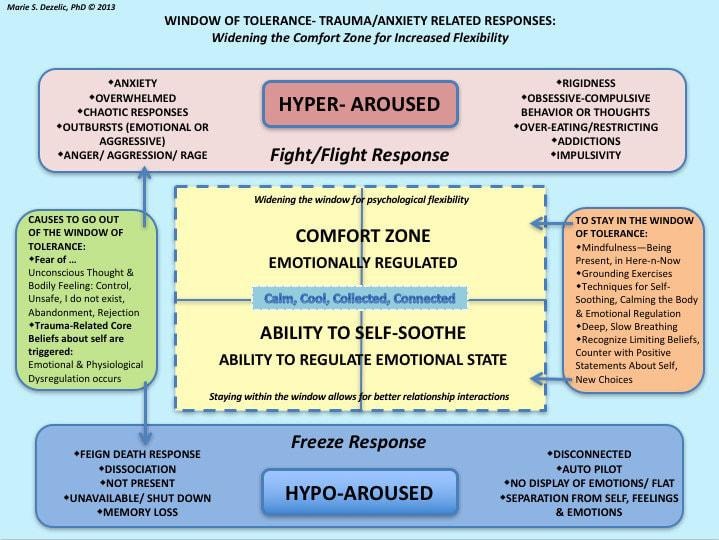
This can apply to so many of us; parents navigating overwhelm, individuals in high-stress jobs, people recovering from or struggling with addiction, or anyone feeling “stuck.” Somatic therapy is not just for people in crisis, it is for anyone who can benefit from getting in, staying in, and expanding their Window of Tolerance.
Reclaiming the Body as Ally
Somatic therapy is not about doing something “weird” or “woo woo,” but about returning to our body’s natural wisdom. Curiosity is the first step; notice your breath, your posture, your heartbeat, etc and you’re already beginning somatic awareness. If you are interested in working with a therapist trained in one of the many somatic approaches, reach out to Wildflower’s intake team at 312-809-0298 or by filling out an online inquiry form.
Further Exploration
PODCASTS
Being Well Podcast — “Somatic Psychology: Using the Body to Heal the Mind” Host Rick Hanson sits down with somatic therapist Elizabeth Ferreira for an inviting conversation about what somatic therapy looks like in practice and why the body matters in healing. Listen here
The Trauma Therapist Podcast (Guy Macpherson, PhD) Conversations with pioneers like Bessel van der Kolk, Peter Levine, and Pat Ogden. A thoughtful resource for clinicians and anyone exploring trauma recovery from a body-based perspective. thetraumatherapistproject.com
Somatic Uprising Podcast Explores embodiment through story, spirituality, and neuroscience. Compassionate and inclusive; ideal for both practitioners and anyone seeking embodied self-understanding. Listen here
Sounds True: Insights at the Edge Host Tami Simon interviews thought leaders like Deb Dana, Stephen Porges, and Peter Levine on mindfulness, neuroscience, and the body’s innate capacity to heal. soundstrue.com/podcast
The Embody Podcast (Candice Wu) Blending creativity, energy work, and somatic awareness, Candice Wu brings the language of the body into everyday life. candicewu.com/podcast
BOOKS
The Body Keeps the Score: Brain, Mind, and Body in the Healing of Trauma by Bessel van der Kolk, MD. A modern classic that bridges neuroscience, psychology, and lived experience, illustrating how trauma reshapes both mind and body- and how healing must engage both.
Waking the Tiger: Healing Trauma by Peter A. Levine, PhD. A foundational introduction to somatic experiencing and the body’s innate ability to restore balance after trauma.
In an Unspoken Voice: How the Body Releases Trauma and Restores Goodness by Peter A. Levine, PhD. A deeper exploration into the physiology of trauma and how we can safely reconnect with the body’s natural rhythms of healing.
The Polyvagal Theory in Therapy: Engaging the Rhythm of Regulation by Deb Dana, LCSW. An accessible and practical guide that translates Stephen Porges’ polyvagal theory into everyday language and therapeutic tools.
Trauma and the Body: A Sensorimotor Approach to Psychotherapy by Pat Ogden, Kekuni Minton, & Clare Pain. A foundational text integrating movement, mindfulness, and awareness into trauma treatment.
Complex PTSD Workbook: A Mind-Body Approach to Regaining Emotional Control and Becoming Whole by Arielle Schwartz, PhD. A compassionate workbook blending somatic practices, mindfulness, and cognitive strategies for trauma recovery.
The Somatic Psychotherapy Toolbox: 125 Worksheets and Exercises for Trauma & Stress by Manuela Mischke-Reeds, MA, LMFT. An accessible, practice-oriented collection of grounding, resourcing, and regulation tools for both clients and clinicians.
References
Anderson, M. (n.d.). So, what are we fraught with this week? Andertoons. https://www.andertoons.com/therapy/cartoon/6904/so-what-are-we-fraught-with-this-week
Bessel van der Kolk, M. D. (n.d.). https://www.besselvanderkolk.com/. Retrieved October 6, 2025, from https://www.besselvanderkolk.com
Cobb, S. (2025, June 9). Tuning in: How the vagus nerve helps you come home to your body. Wildflower Center for Emotional Health. https://www.wildflowerllc.com/tuning-in-how-the-vagus-nerve-helps-you-come-home-to-your-body/
Dezelic, M. S. (2013). Window of tolerance: Trauma/anxiety related responses: Widening the comfort zone for increased flexibility [Diagram]. Marie S. Dezelic, PhD.
Dr. Dan Siegel. (n.d.). Dr. Dan Siegel Home Page. Retrieved October 13, 2025, from https://drdansiegel.com/
Ergos Institute, Inc. (n.d.). https://www.somaticexperiencing.com/about-peter. Somatic Experiencing®. Retrieved October 6, 2025, from https://www.somaticexperiencing.com/about-peter
Levine, P. A. (1997). Waking the Tiger: Healing Trauma. North Atlantic Books.
Odarczenko, A. (2022, February 24). Fight or flight: What your stress response actually does and why. Wildflower Center for Emotional Health. https://www.wildflowerllc.com/fight-or-flight-what-your-stress-response-actually-does-and-why/
Porges, S. W. (n.d.).https://www.stephenporges.com/. Retrieved October 6, 2025, from https://www.stephenporges.com
Porges, S. W. (2011). The Polyvagal Theory: Neurophysiological Foundations of Emotions, Attachment, Communication, and Self-Regulation. W. W. Norton.
Reagan, L. (2021, October 22). Trauma treatment modality series: “Top-down” and “bottom-up” approach to therapy. Trauma Therapist Network. https://traumatherapistnetwork.com/trauma-treatment-modality-series-top-down-and-bottom-up-approach-to-therapy/
Sensorimotor Psychotherapy Institute. (n.d.). https://sensorimotorpsychotherapy.org/therapist-directory/pat-ogden-phd/. Retrieved October 6, 2025, from https://sensorimotorpsychotherapy.org
van der Kolk, B. A. (2014). The Body Keeps the Score. Viking.
Wikipedia contributors. (n.d.). Wilhelm Reich. In Wikipedia, The Free Encyclopedia. Retrieved October 6, 2025, from https://en.wikipedia.org/wiki/Wilhelm_Reich
Wikipedia contributors. (n.d.). Thomas Louis Hanna. In Wikipedia, The Free Encyclopedia. Retrieved October 6, 2025, from https://en.wikipedia.org/wiki/Thomas_Louis_Hanna
Wikipedia contributors. (n.d.). Alexander Lowen. In Wikipedia, The Free Encyclopedia. Retrieved October 6, 2025, from https://en.wikipedia.org/wiki/Alexander_LowenYouTube. (Dec 21, 2021). Window of Tolerance and Emotional Regulation (Dr Dan Siegel). YouTube. https://www.youtube.com/watch?v=TNVlppGz0zM