
Like many of us during this winter season, I was recently hit hard by a cold and cough. The symptoms seemed to last forever, with each day hoping for some relief to come but it only seemed to get worse. Finally on day ten, I sought medical care and patiently waited for my turn. As the care team reviewed my recent symptoms and asked basic questions, I rehearsed in my head the line I wanted to use to be able to advocate for myself. When it came time for the uncomfortable throat and nose swabs, I said to the tech “I find it really helpful if you can tell me exactly what you are doing and even use a count so I know how long the discomfort will last.” This simple request made a huge difference in my experience and although it’s a small example, it helped me to feel empowered to advocate for myself in a healthcare setting.
On January 23rd we will observe Maternal Health Awareness Day to draw attention to the significance of maternal health and efforts to reduce maternal mortality (Northwest Women’s Clinic, 2025). Maternal Health is a personal, local, national, and international issue. The statistics are staggering: United States holds one of the highest rates of maternal mortality among wealthier countries and great racial disparities exist as evidenced by the rate of Black maternal death being almost three times that of white mothers (Thomas et al., 2024). There are many factors contributing to this crisis including the time-limited nature of visits with medical providers and the gap between delivery and the first postpartum visit at six weeks in which complications can develop, just to name a few (Columbia Mailman School of Public Health, 2025).
Many organizations, including the American College of Obstetricians and Gynecologists, are directly working to address the more than 80% of deaths, estimated by the CDC, that occur during and after pregnancy that are preventable (American College of Obstetricians & Gynecologists, n.d.). At Wildflower, we believe that wellbeing can be experienced when all parts of our mental, physical, and emotional health can be addressed and met. The critical pieces to effectively obtain help with our healthcare concerns include education regarding warning signs, access to support and resources, and ability to advocate for ourselves (Northwest Women’s Clinic, 2025).
Maternal Health—Before, During and After Pregnancy
While so much of the focus can be on the healthy delivery of a baby, maternal health includes the need for holistic care before and throughout our pregnancy journey as well as postpartum (Northwest Women’s Clinic, 2025). The National Center for Chronic Disease Prevention and Health Promotion (NCCDPHP); Division of Reproductive Health (2024) launched the Hear Her Campaign to share life-saving information regarding urgent warning signs for pregnant and postpartum women. Among the important resources, are the Urgent Maternal Warning Signs:
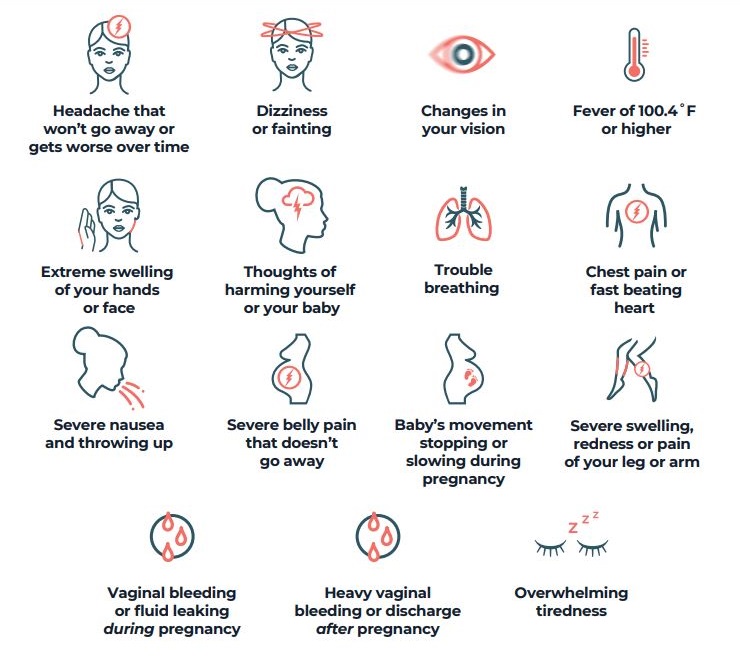
Source: National Center for Chronic Disease Prevention and Health Promotion (NCCDPHP); Division of Reproductive Health. (2024, May 15). Urgent Maternal Warning Signs.
Knowledge is power and by equipping both yourself and your support network with information on the signs to seek medical attention everyone can advocate for the needed care.
Allyson Felix, an Olympic gold medalist champion sprinter, planned for a natural birth (Columbia Mailman School of Public Health, 2025). Her vision for the delivery of her first child was turned upside down when she learned she had preeclampsia, a potentially life-threatening complication in pregnancy. Felix understandably was surprised that an elite athlete like herself could develop high blood pressure. As a result, she was admitted to the hospital for an emergency C-section at 32 weeks. The swift action taken by her medical team may have been life saving . Stories like Allyson’s are more common than we may realize. Across the United States and the world, many women are diagnosed with unexpected and at times severe health problems related to pregnancy and postpartum recovery. As a result of this experience, Felix has become a strong advocate for maternal health and raising awareness (National Center for Chronic Disease Prevention and Health Promotion (NCCDPHP); Division of Reproductive Health, 2024).
Early Detection and Intervention
Early detection of any health-related concern is a critical way in which we can protect our wellbeing. By engaging in consistent check-ups with our healthcare providers, we give ourselves the best chance to quickly and effectively intervene, increasing the probability of treatment success and possibly minimizing the necessity of more aggressive interventions. For reproductive health concerns, early detection can provide the opportunity to proactively manage symptoms and mitigate possible complications (River City OBGYN, 2024).
When Asking for Help Feels Hard
While there can be many external barriers to accessing the healthcare we need, at times we find there are also internal barriers that we need to face in order to move forward. If asking for help is feeling difficult for you right now, it might be beneficial to explore why that is and what can be done to address these hesitations. Is there a fear of being seen as “difficult”? Have you had a previous uncomfortable experience in a medical setting? Are you worried that your concerns won’t be taken seriously? Identifying any internal barriers we might hold can be a helpful first step in this process. Additionally, is there a support person in your life who could help you to talk through these barriers and attend a medical appointment with you?
The Importance and Benefits of Advocating for Your Maternal Health (Hutchens)
The idea of self-advocacy in a healthcare setting includes components of education, communication, and decision making (Hutchens et al., 2023). By equipping ourselves with pertinent information about our health, we can feel more confident to not only assertively communicate our concerns, needs, and preferences, but also to see ourselves as active participants and decision-makers in our care (Hutchens et al., 2023).
Researchby Hutchens et al. (2023) of Australian women with cardiac disease in pregnancy and postpartum described the many benefits of self-advocacy including improved quality of life, increased engagement with preventative healthcare, and reduced impact of symptoms. Possessing a sense of autonomy and control over our care can also benefit our mental health. Additionally, the experience of being able to influence our own care could encourage us to address concerns in other areas of our lives (Hutchens et al., 2023).
Steps to Advocate for your Health
While it may seem daunting to advocate for yourself in a healthcare setting, there are several simple steps and tips to help you feel prepared and empowered for your next visit. Preparing questions beforehand, and then asking questions during your appointment, is an important part of your healthcare that can help you understand your care plan and collaborate in the process (Northwest Women’s Clinic, 2025).
Secondly, you are the expert on your lived experience and if you notice any concerning changes to your physical health or signs of mental health needs, reach out and communicate with your healthcare providers (Northwest Women’s Clinic, 2025). They will be able to connect you with the right support whether that be a mental health therapist or pelvic floor specialist.
Maternal health matters because taking care of ourselves physically, mentally, and emotionally helps us to be able to care for our families. When we board a plane, parents are always reminded to first put on our own masks, and the same is true in caring for our health (Northwest Women’s Clinic, 2025).
We encourage you to reach out if you are in need of resources or information. Here at Wildflower, our therapists are knowledgeable about the vast healthcare resources available and can help connect you to the service you need. We believe that helping clients overcome barriers to accessing providers is an essential part of overall wellbeing and care. If you are interested in learning more about mental health services at Wildflower, please reach out to our Intake Team on our contact page or call (312) 809-0298.
References
Hutchens, J., Frawley, J., & Sullivan, E. A. (2023). Is self-advocacy universally achievable for patients? The experiences of Australian women with cardiac disease in pregnancy and postpartum. International Journal of Qualitative Studies on Health and Well-Being, 18(1). https://doi.org/10.1080/17482631.2023.2182953
National Center for Chronic Disease Prevention and Health Promotion (NCCDPHP); Division of Reproductive Health. (2024, May 15). Signs and Symptoms of Urgent Maternal Warnings Signs.
National Center for Chronic Disease Prevention and Health Promotion (NCCDPHP); Division of Reproductive Health. (2024, May 15). Unexpected Pregnancy Complications: Allyson Felix’s Story. https://www.cdc.gov/hearher/allyson-felix/index.html
Northwest Women’s Clinic. (2025, January 24). Maternal Health Awareness Day: How to Advocate for Your Health. https://nwwc.com/maternal-health-awareness-day-how-to-advocate-for-your-health/
Maternal Health Awareness Day. (n.d.) American College of Obstetricians & Gynecologists. Retrieved January 9, 2026 from
River City OBGYN. (2024, April 1). Early Detection: The Key to Women’s Health. https://rivercityobgyn.com/early-detection-the-key-to-womens-health/
Taking Big Strides Towards Improved Maternal Health. (2015, June 11). Columbia Mailman School of Public Health. Retrieved January 11, 2026 from https://www.publichealth.columbia.edu/news/taking-big-strides-towards-improved-maternal-health
Thomas, T. H., Vetterly, S., Kaselitz, E. B., Doswell, W., & Braxter, B. (2024). Self‐Advocacy Among Black Women During the Perinatal Period: Prevalence and Relationship to Patient Experiences. Birth: Issues in Perinatal Care, 52(2), 291–298. https://doi.org/10.1111/birt.12885